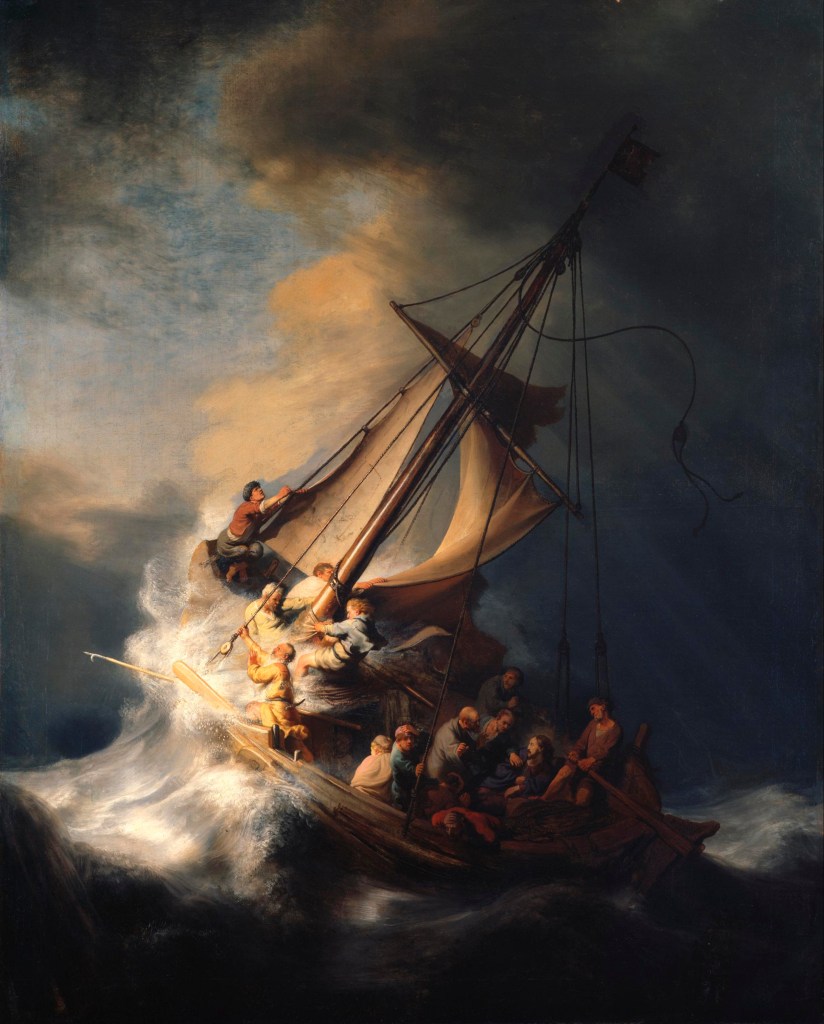
Rembrandt. Christ in the Storm on the Sea of Galilee. 1633, oil, location unknown.
ART ANALYSIS
On March 18, 1990 at 1:24 am the Isabella Stewart Gardner Museum in Boston, Massachusetts was robbed. Two men dressed as police officers deceived and subdued the security guards on duty. 13 works of art. 81 minutes. Est. $500,000,000 in value. The FBI conducted an investigation with little to no results and the art remains lost to this day. The frame that once held this painting now hangs barren on the grieving walls of a museum holding the record for the largest property theft in history.
Rembrandt was a master painter. His works have captivated the minds of generations of artists and art enthusiasts who appreciate his sense of uncompromising realism. Rembrandt’s technique is brilliant, manipulating light and shade to create masterpieces of historical and religious significance.
This painting is quite interesting, and not merely because of the circumstances surrounding its disappearance. The composition is triangular, positioning the boat in the middle. Rembrandt has captured the essence of an intense storm or “furious squall,” as the NIV says. (Mark 4:37) The waves are rocking the boat fiercely and looks as if it is just about to capsize. The recently awoken Jesus is to the right peering up toward the terrified disciples scrambling to save the boat and, most assuredly, themselves. Rembrandt, as he often did, painted himself into the composition as one of the disciples. He sits in the middle of the boat peering straight into the viewer’s soul.
VISUAL EXEGESIS
In the Bible, we find the account of Jesus calming the storm in the Synoptic Gospels: Matthew (8:23-27), Mark (35-41), and Luke (8:22-25). Here’s a paraphrase. Prior to this event, Jesus had been teaching for an extended period of time and was tired. He and the disciples got in a boat to cross the Sea of Galilee to do more ministry on the other side. Jesus fell asleep. While on the water, a great storm engulfed the sea and the disciples were terrified. They ran to Jesus, woke him up, and asked the question, quite audaciously, “Don’t you care if we drown?”
Let’s pause there.
“DON’T YOU CARE IF WE DROWN?” This question was not asked by casual acquaintances or fans of Jesus, but from the disciples. Those who saw Jesus teach, preach and do miracles. They witnessed the love he had shown to countless people, many of whom were the “least of these.” (Matt. 25:45) Yet, in a moment of fear they question the heart of their Lord.
Christians, let us not be quick to condemn, as we; I am prone to do the same.
What happened next is a picture of how a gracious God deals with an unfaithful people. Jesus calmly got up, and rebuked the wind and waves saying, “Peace, be still.” Then he asked the disciples, “Why are you afraid? How is it you have no faith?” The disciples were terrified and asked each other the question “What kind of man is this, that even the wind and waves obey him?”
This event is often preached with the declaration, “Just as Jesus calmed the storm on the Sea of Galilee, so can he calm the storms in your life.” I affirm this. However, this account in Matthew, Mark and Luke is about so much more than that. It is true that Jesus can grant us peace amid the difficult seasons, or “storms” of life. It is true that even when our boat is sinking, if we are in Christ, he is in the boat with us. He never leaves us nor forsakes us. This is true. However, the emphasis in these texts are not the pastoral or philosophical application to calm our hearts amid difficult circumstances, but rather to show the sheer power and authority that Jesus has over all of creation. The reason that Jesus can calm the “storms” in your life, is because he is God! All of creation is under his Lordship.
In a homily given on Matthew’s account, the early church father Chrysostom highlights the disciple’s struggle to recognize Jesus as the God-man. Chode in this sense refers to dealing harshly with.
“But Christ chode not with them for calling Him a man, but waited to teach them by His signs, that their supposition was mistaken. But from what did they think Him a man? First from His appearance, then from His sleeping, and His making use of a ship. So on this account they were cast into perplexity, saying,
What manner of man is this?since while the sleep and the outward appearance showed man, the sea and the calm declared Him God.”1St. John Chrysostom
Chrysostom, along with the majority of the early church, affirmed the reality of Christ’s two natures. Jesus is fully God and fully man.
THEOLOGICAL INVESTIGATION
Throughout the history of the Church many false teachings have risen against the reality of Christ’s human and divine natures. Arius taught there was “a time when the son was not,” arguing that Christ was a created being. This concept is homoiousios meaning “similar being.” The council of Nicaea (325), which was brought about to address these heretical views, later declared that Jesus was homoousis meaning he was of the “same being” with the Father. Later, Apollinarius denied the full humanity of Christ, which was addressed at the Council of Constantinople (381).
There is so much more to explore on this topic, such as the Hypostatic union, the unity of Christ’s two natures in one person. I’d like to end this section with the Nicene Creed. If you are unfamiliar with it I encourage you to read it a few times.
T H E N I C E N E C R E E D
I believe in one God, the Father Almighty,
Maker of heaven and earth, and of all things visible and
invisible.
And in one Lord Jesus Christ, the only-begotten Son of God,
begotten of the Father before all worlds;
God of God, Light of Light, very God of very God;
begotten, not made, being of one substance with the Father,
by whom all things were made.
Who, for us men and for our salvation,
came down from heaven
and was incarnate by the Holy Spirit of the Virgin Mary,
and was made man;
and was crucified also for us under Pontius Pilate;
he suffered and was buried;
and the third day he rose again, according to the Scriptures;
and ascended into heaven, and sits on the right hand of the
Father;
and he shall come again, with glory, to judge the living and the
dead;
whose kingdom shall have no end.
And I believe in the Holy Spirit, the Lord and Giver of life;
who proceeds from the Father and the Son;
who with the Father and the Son together is worshiped and
glorified;
who spoke by the prophets.
And I believe in one holy catholic and apostolic church.
I acknowledge one baptism for the remission of sins;
and I look for the resurrection of the dead,
and the life of the world to come. Amen. 2
- “Homily 28 on Matthew,” CHURCH FATHERS: Homily 28 on Matthew (Chrysostom), accessed March 18, 2025, https://www.newadvent.org/fathers/200128.htm. ↩︎
- Van Dixhoorn, Chad B. Creeds, Confessions, and Catechisms: A Reader’s Edition. Wheaton, IL: Crossway, 2022. Pg. 15-18 ↩︎
 Sacred Impressions
Leave a comment