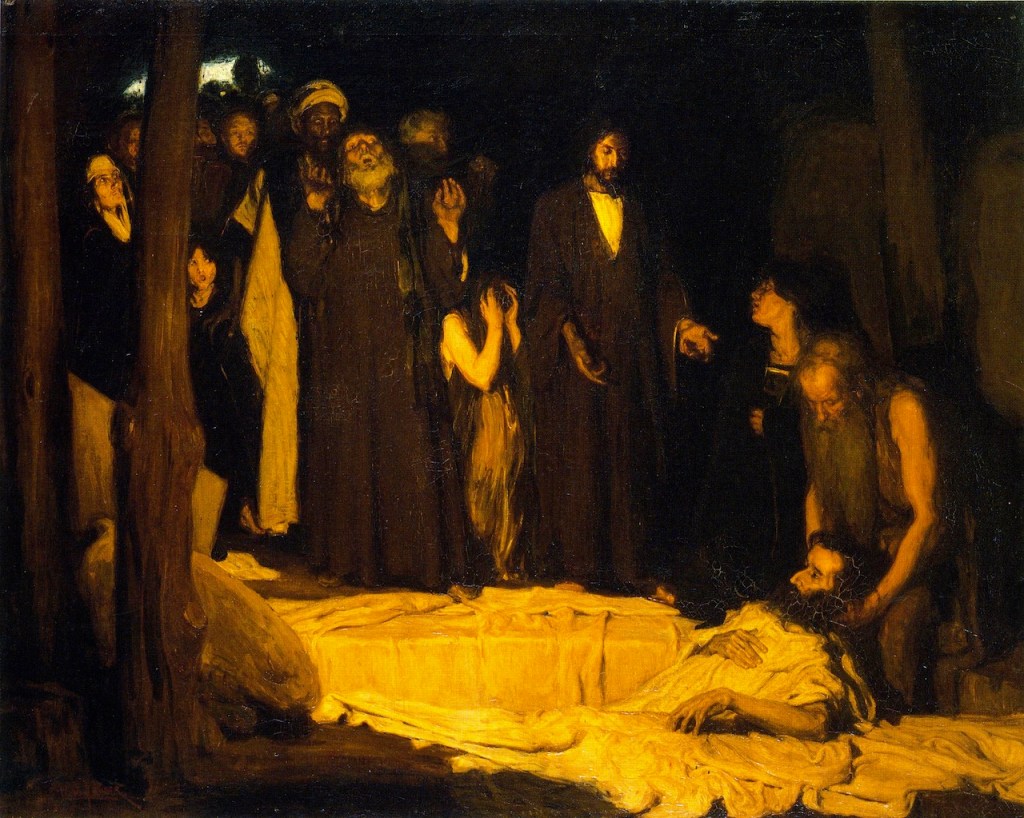
Tanner, Henry Ossawa. The Raising of Lazarus. 1896, oil, Musee d’Orsay
ART ANALYSIS
This painting, which is currently housed in the Musée d’Orsay in Paris, won a medal at the Salon in 1897. Tanner is a master of representational painting, and his ability to manipulate light and shade is clearly evident in this work. The composition is diagonal, placing the focal point, Lazarus, in the lower right corner. Jesus is positioned just off-center in the composition. Surrounding Jesus is a bewildered audience witnessing this miraculous event. In the center, a figure grasps their head, appearing to be in complete shock and disbelief, perhaps even frightened.
VISUAL EXEGESIS
In John 11, we read about Jesus raising his dear friend Lazarus from the dead. I appreciate how Tanner depicts Lazarus in that exact moment of being brought back to life. It seems as though Lazarus has just opened his eyes, and he certainly looks “dazed and confused,” for lack of a better phrase. Just imagine how Lazarus felt when he heard Jesus say, “Come forth.”
Just before this miracle took place, Lazarus’s sister, Martha rebuked Jesus saying, “If you had been here, my brother would not have died.” (John 11:21)
Examine these words Jesus spoke to Martha.
“Jesus said to her, “I am the resurrection and the life. Whoever believes in me, though he die, yet shall he live, and everyone who lives and believes in me shall never die. Do you believe this?””
John 11:25-26 ESV
In his Tractate on John 11, Augustine makes a profound statement about Jesus, emphasizing that he not only possesses the power of resurrection but is, in fact, the embodiment of resurrection itself. His comments transform into an earnest plea for those listening to repent. This is a lengthy quote, but I believe it is worthy of consideration.
Give ear, brethren, give ear to what He says. Certainly the universal expectation of the bystanders was that Lazarus, one who had been dead four days, would live again; let us hear, and rise again. How many are there in this audience who are crushed down under the weighty mass of some sinful habit! Perhaps some are hearing me to whom it may be said,
Be not drunk with wine, wherein is excess;Ephesians 5:18 and they say, We cannot. Some others, it may be, are hearing me, who are unclean, and stained with lusts and crimes, and to whom it is said, Refrain from such conduct, that you perish not; and they reply, We cannot give up our habits. O Lord, raise them again.I am,He says,the resurrection and the life.The resurrection because the life.
– St. Augustine, Tractates on the Gospel of John, Tractate 49 (John 11:1-54)
John 11 is not an account of Jesus “saving” Lazarus, therefore it should not be interpreted merely as a metaphor for the work of salvation. Jesus literally, actually, and physically, raised Lazarus from the dead. Yet, Augustine highlights that this reality of Jesus as Lord over life and death, should lead us to repentance.
The subsequent exhortation from Jesus for Lazarus is to “take off the grave clothes.” (John 11:43) The imagination aids in my understanding of this phrase. It is inappropriate for someone who is alive to wear grave clothes. Grave clothes are bacteria infested, soiled, and frankly, gross. So is our sin. As a disease infects, breaks down and destroys the body, even more does our sin kills the body and soul. It is inappropriate for someone who Christ has made alive to continue in sin. May we live in ongoing confession and repentance, through the power of the Holy Spirit, as those who have been made alive in Christ.
THEOLOGICAL INVESTIGATION
In this section, I’d like to examine an interesting point of discussion on the term “resurrection.” The Greek “ἀνάστασις” occurs approximately 42 times in the New Testament to refer to resurrection.1 The Latin word resurrectio, meaning “to rise again,” refers to a person returning to life after being previously dead. N.T. Wright initially defines resurrection as “that someone who was truly dead had truly come back into the world of the living.”2 St. Thomas Aquinas defined resurrection as “a restoration from death to life.”3 The contemporary exegetical interpretation is often a point of discussion. Some theologians argue that the term does not accurately communicate what is happening in passages such as John 11 and have posed a “better” exegetical interpretation. In Dr. Adam Harwood’s Christian Theology, he states, “The word “resurrection” is not the proper term for a dead person being raised to life; “resuscitation” is a better term for the raising of individuals such as Lazarus in John 11 and Dorcas in Acts 9.”4
Wright and Harwood, along with others, have deemed the term “resuscitation” more fitting for biblical accounts where “resurrection” is used referring to anyone other than Jesus. The reality in John 11 is that Lazarus would die again. Thus, resurrection, in this sense, refers not only to never dying again but also transformation into a new “eternal” embodiment. In a recent conversation with a fellow pastor and friend, the term “reanimation” was posed as a better exegetical interpretation. Aquinas however, would argue that it was in fact resurrection, but an imperfect one, since Lazarus was only rescued from actual death instead of eternal spiritual death. Therefore, for Aquinas, resurrection is sufficient to describe these events, yet the idea is communicated that Christ’s resurrection was the antitype and greater (more permanent) resurrection.
All things considered, there seem to be no major implications for differentiating between resurrection, resuscitation, or reanimation as long as the eternal and glorified nature of Christ’s bodily resurrection is affirmed. That being said, if you’re concerned about it, it’s usually a good rule of thumb to stick with what scripture says. (He wrote with a hint of sarcasm.)
THIS POST WAS UPDATED AND REVISED ON MARCH 14, 2025
- The search for the Greek verb forms of ἀνάστασις was performed by Logos Bible Software. ↩︎
- N.T. Wright, The Resurrection of the Son of God, vol. 3 of Christian Origins and the Question of God (Minneapolis: Fortress, 2003) pg. 71. ↩︎
- Thomas Aquinas, “Summa Theologiae,” III, q.53, a.3 ↩︎
- Adam Harwood, Christian Theology: Biblical, Historical, Systematic (Bellingham, WA: Lexham Academic, 2022), 433. ↩︎

 Sacred Impressions
Leave a comment